


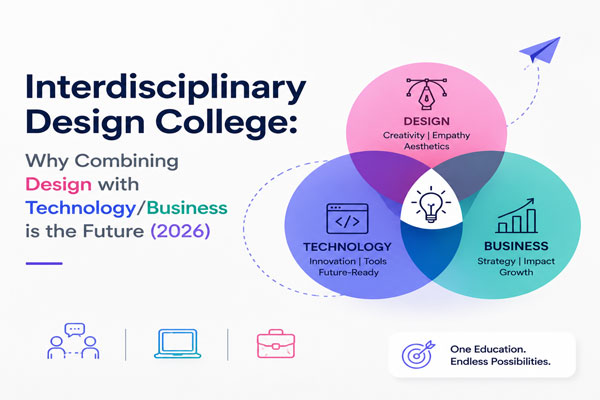
Interdisciplinary Design College – Design + Tech/Business 2026
Gone are the days when designers only needed to be “creatively talented.”
Today’s most successful designers understand technology, business strategy, psychology, and sustainability. They solve complex problems, lead cross-functional teams, and directly impact company revenue. This shift has sparked a new movement in design education: interdisciplinary design colleges.
An interdisciplinary design college teaches design alongside technology, business, environmental studies, and other fields. Graduates emerge as complete problem-solvers, not just decorators.
This comprehensive guide explains why interdisciplinary design education is the future, how it differs from traditional design schools, and how it impacts your career and earning potential.
Why Interdisciplinary Design is the Future
Technology is Reshaping Design
Reality: Design is no longer separate from development.
Modern design requires understanding:
- How to prototype with code
- UI interactions and animations
- Performance implications of design decisions
- Development constraints and possibilities
- Data visualization and information architecture
Impact: Designers who understand code earn ₹3-5 lakhs more annually.
Business Impact Matters More
Reality: Design’s value is measured in business outcomes.
Companies now ask designers:
- How does this increase user retention by X%?
- What’s the ROI of this redesign?
- How does this reduce customer churn?
- What’s the competitive advantage?
Impact: Designers with business acumen become design leaders and earn ₹10-15 lakhs more over their career.
Products Are Complex
Reality: Single-discipline designers can’t solve modern problems.
Building an app requires understanding:
- Design: User interface and experience
- Technology: How to code the interactions
- Business: What users need and pay for
- Data: User behavior and metrics
- Psychology: How humans make decisions
- Sustainability: Environmental impact
Impact: Interdisciplinary graduates are hired for higher roles (design manager, product manager) immediately.
Startups Demand Multi-Skilled People
Reality: 80% of startups can’t afford separate specialists.
They need designers who can:
- Design the product
- Contribute to product strategy
- Understand business metrics
- Assist with development
- Communicate with investors
Impact: Startup employees with interdisciplinary skills earn equity worth ₹50-500+ lakhs.
AI is Changing Design
Reality: AI tools are automating design tasks.
Designers need to:
- Use AI tools effectively
- Understand AI limitations
- Focus on strategy and innovation
- Solve problems AI can’t
- Lead AI-powered design teams
Impact: Designers trained in AI + design earn 40% more and have more job security.
What is Interdisciplinary Design Education?
Interdisciplinary design education combines design fundamentals with:
- Technology/Engineering – Understanding code, prototyping, product development
- Business/Economics – Strategy, market analysis, product management
- Psychology/Sociology – User behavior, social design, human-centered thinking
- Sustainability – Environmental impact, ethical design
- Data & Analytics – Metrics, user research, design measurement
- Leadership – Team management, communication, strategic thinking
Traditional Design Education vs. Interdisciplinary
| Aspect | Traditional Design | Interdisciplinary Design |
| Focus | Design skills and aesthetics | Design + business + tech + sustainability |
| Curriculum | 80% design, 20% theory | 50% design, 50% other disciplines |
| Tools Taught | Adobe, Figma, sketching | Adobe, Figma + code tools + business software |
| Case Studies | Famous design projects | Real business problems with solutions |
| Faculty | Designers, design theorists | Designers + engineers + MBAs + psychologists |
| Projects | Design brief responses | Real client work, startups, social projects |
| Career Outcome | Designer roles | Design + PM + entrepreneurship roles |
| Starting Salary | ₹3.5-5.5 lakhs | ₹5-8 lakhs |
| 5-Year Salary | ₹8-10 lakhs | ₹12-16 lakhs |
How Interdisciplinary Training Changes Your Career
Case Study 1: Design → Design Manager → Product Manager
Without Interdisciplinary Education:
- Year 0-3: Graphic designer (₹4-6 lakhs)
- Year 3-5: Senior designer (₹8-10 lakhs)
- Year 5-8: Design manager (₹12-15 lakhs)
- Can’t move to PM (lacks business/tech knowledge)
With Interdisciplinary Education:
- Year 0-3: Designer (₹5-7 lakhs) with PM knowledge
- Year 3-4: Design + PM hybrid role (₹10-13 lakhs)
- Year 4-6: Product Manager (₹15-22 lakhs)
- Year 6+: Senior PM/Director (₹25-50+ lakhs)
Salary Difference: ₹40-60 lakhs more over 10 years
Case Study 2: Design → Entrepreneurship
Without Interdisciplinary Education:
- Years 0-5: Designer at companies (₹5-12 lakhs)
- Year 5: Wants to start company but lacks business/tech skills
- Takes time to learn or finds co-founders
- Slow startup growth
With Interdisciplinary Education:
- Years 0-3: Designer + understands business and tech (₹5-7 lakhs)
- Year 3: Can launch startup immediately with technical knowledge
- Year 3-5: Builds ₹50+ lakh revenue company
- Year 5+: Company valued at ₹5-10+ crores
Impact: ₹50 lakhs+ additional value in equity
Case Study 3: Design → Tech Leadership
Without Interdisciplinary Education:
- Designer path doesn’t naturally lead to tech leadership roles
- Must change fields or take unrelated roles
- Takes longer to reach senior levels
With Interdisciplinary Education:
- Year 0-3: Designer with tech understanding (₹6-8 lakhs)
- Year 3-5: Lead designer in tech team (₹12-15 lakhs)
- Year 5-8: Design director or Head of Product Design (₹20-30+ lakhs)
- Can naturally move to VP/C-suite roles
Salary Difference: ₹30-50 lakhs more over career
Skills You Gain in Interdisciplinary Design Education
How Interdisciplinary Design Affects Salary
Entry-Level Salary Difference
| Education Type | Salary | Additional Skills | Job Opportunities |
| Traditional Design | ₹3.5-5 lakhs | Design only | Designer roles |
| Interdisciplinary Design | ₹5-8 lakhs | Design + business/tech | Designer, junior PM, startups |
| Design + Coding | ₹5.5-7.5 lakhs | Design + development | Designer, developer hybrid |
| Design + Business MBA | ₹6-9 lakhs | Design + strategy | PM, strategist roles |
5-Year Salary Progression
- Traditional Design: ₹8-10 lakhs
- Interdisciplinary Design: ₹12-16 lakhs
- Difference: ₹4-6 lakhs annually = ₹20-30 lakhs over 5 years
10-Year Career Earnings
- Traditional Design: ₹1.2-1.5 crores
- Interdisciplinary Design: ₹2-2.5 crores
- Difference: ₹50-100 lakhs additional earnings
Career Options & Salary (5+ years experience)
| Career Path | Salary | Requires |
| Design Manager | ₹15-22 lakhs | Leadership skills |
| Product Manager | ₹16-25 lakhs | Business + design knowledge |
| Startup Founder | ₹20-200+ lakhs | Entrepreneurship knowledge + tech understanding |
| Consultant | ₹15-30+ lakhs | Strategic thinking + communication |
| Design Director | ₹20-35 lakhs | Design expertise + business sense |
| Head of Product | ₹30-50+ lakhs | Design + business + tech knowledge |
| Freelance (High-End) | ₹30-100+ lakhs | Design + business consulting skills |
Key Insight: Interdisciplinary designers have more career options and higher earning potential at every level.
Interdisciplinary Design vs. Related Fields
Design vs. Product Management
| Aspect | Design | Product Management |
| Focus | How it looks and feels | What product to build and why |
| Salary (Entry) | ₹5-7 lakhs | ₹8-12 lakhs |
| Salary (Senior) | ₹15-25 lakhs | ₹20-35 lakhs |
| Growth | Design manager → Director | PM → Senior PM → Director |
Insight: PMs earn more, but interdisciplinary designers can become PMs.
Design vs. Engineering
| Aspect | Design | Engineering |
| Focus | User experience | Technical implementation |
| Salary (Entry) | ₹5-7 lakhs | ₹6-9 lakhs |
| Salary (Senior) | ₹15-25 lakhs | ₹18-35 lakhs |
| Growth | Design leadership | Tech leadership |
Insight: Both pay similarly, but engineers slightly higher. Interdisciplinary designers bridge both.
Design vs. MBA
| Aspect | Design | MBA |
| Focus | Problem-solving through design | Business strategy and management |
| Salary (Entry) | ₹5-8 lakhs | ₹10-14 lakhs |
| Salary (Senior) | ₹15-30 lakhs | ₹25-50 lakhs |
| Cost | ₹8-16 lakhs | ₹20-40 lakhs |
| ROI | Good, practical skills | Excellent, broad opportunities |
Insight: MBA higher salary but higher cost. Interdisciplinary design offers design expertise + business knowledge at lower cost.
Why Companies Prefer Interdisciplinary Designers
Solve Problems Faster
- Don’t need to coordinate with multiple specialists
- Can prototype ideas quickly
- Understand business constraints
- Make faster decisions
Better Product Outcomes
- Design with business and tech understanding
- Make informed trade-offs
- Create sustainable solutions
- Reduce failed projects
Cost Effective
- Pay one person for multiple roles
- Reduce hiring and coordination costs
- Faster time to market
- Better ROI on design work
Leadership Potential
- Naturally fit for management roles
- Can manage diverse teams
- Understand different perspectives
- Make strategic decisions
Startup Friendly
- Early stage needs multi-skilled people
- Equity worth more than salary
- Faster company growth
- Higher equity value
Final Recommendation: How to Earn ₹20+ Lakhs as Designer
Curriculum Balance
- [ ] 50%+ design skills (core)
- [ ] 20%+ business/strategy content
- [ ] 15%+ technology/technical content
- [ ] 10%+ humanities/psychology/sustainability
- [ ] Real projects with companies or startups
Faculty Diversity
- [ ] Designers with industry experience
- [ ] Engineers or technologists teaching
- [ ] Business professionals or MBAs on faculty
- [ ] Guest lecturers from startups/companies
- [ ] Mentorship from multiple disciplines
Industry Partnerships
- [ ] Companies recruiting graduates
- [ ] Internship opportunities in tech/startups
- [ ] Real client projects during courses
- [ ] Guest lectures from industry leaders
- [ ] Startup incubation or connections
Technology Integration
- [ ] Coding/prototyping courses offered
- [ ] Access to coding tools and environments
- [ ] Emerging tech labs (AR, VR, AI, IoT)
- [ ] Collaboration with engineering programs
- [ ] Updated with latest tech trends
Business Education
- [ ] Product management fundamentals
- [ ] Business strategy courses
- [ ] Entrepreneurship/startup courses
- [ ] Finance and metrics education
- [ ] Communication and pitch training
Practical Learning
- [ ] Real client projects during course
- [ ] Startup mentorship or incubation
- [ ] Live design challenges with companies
- [ ] Industry visits and guest lectures
- [ ] Post-graduation support for startups
The Future of Design Education
Design Education Trends:
- More Technology Integration – Coding and prototyping essential
- More Business Focus – Design thinking applied to business problems
- Sustainability Emphasis – Environmental and social impact
- AI & Emerging Tech – AR, VR, voice interfaces, AI design
- Entrepreneurship Support – Helping graduates launch startups
- Global Exposure – International collaborations and exchanges
- Specialization Options – Different tracks for different interests
Impact on Your Career:
- Pure graphic designers decreasing in demand
- Interdisciplinary designers increasingly valuable
- Design leadership roles require business acumen
- Startup opportunities for technically-skilled designers
- Freelance rates higher for multi-skilled designers
Making the Decision: Should You Choose Interdisciplinary?
Choose Interdisciplinary Design If:
- ✓ Want higher earning potential (₹20+ lakhs vs ₹15 lakhs)
- ✓ Interested in product management or entrepreneurship
- ✓ Want to start your own company
- ✓ Like technology and understanding how things work
- ✓ Enjoy business and strategy thinking
- ✓ Want more career flexibility and options
- ✓ Want to avoid being “just a designer”
Choose Traditional Design If:
- ✓ Pure passion for visual design and aesthetics
- ✓ Specialized interest (fashion, interior, graphic)
- ✓ Not interested in technology or business
- ✓ Prefer pure design thinking
- ✓ Want to master craft in depth
The Honest Truth:
Interdisciplinary design is becoming the standard. Most top design jobs now expect business and/or technical knowledge. Pure design skills alone are increasingly insufficient.
Even if you choose traditional design education, you should self-educate in:
- Basic coding or prototyping
- Business and metrics understanding
- Product thinking
- Leadership and communication
Recommended Interdisciplinary Learning Path
Phase 1: Design Foundation (Year 1)
- Learn design principles and tools
- Study design thinking
- Build first projects
- Skill: Visual design, problem-solving
Phase 2: Business Understanding (Year 2)
- Understand product strategy
- Learn basic business metrics
- Study user behavior
- Take business/marketing courses
- Skill: Design thinking + business thinking
Phase 3: Technology Integration (Year 2-3)
- Learn HTML/CSS basics
- Understand prototyping with code
- Build interactive prototypes
- Study emerging technologies
- Skill: Design + technical understanding
Phase 4: Specialization (Year 3-4)
- Choose PM, entrepreneurship, or advanced design
- Build portfolio in chosen area
- Do internships in chosen field
- Skill: Specialized expertise + broad knowledge
Phase 5: Leadership (Year 4+)
- Lead projects or teams
- Develop communication skills
- Build network
- Skill: Design expertise + leadership
Conclusion
Interdisciplinary design education is the future. The most successful designers—and the highest-paid ones—combine design expertise with business acumen, technical understanding, and leadership skills.
Key Takeaways:
- Demand is rising: Companies want multi-skilled designers
- Salary is higher: Interdisciplinary designers earn ₹4-6 lakhs more annually
- Career options are broader: Can become PM, founder, director, consultant
- It’s becoming standard: Pure design skills alone are increasingly insufficient
Your Choice:
- Quick path: Join interdisciplinary college (4 years, ₹10-16 lakhs)
- Self-directed: Design degree + self-learning (4+ years, ₹5-15 lakhs)
- Fast-track: Design degree + bootcamp (4-5 years, ₹8-15 lakhs)
- Career switch: Online + projects (2-4 years, ₹2-5 lakhs)
My Recommendation: If you’re starting fresh, choose an interdisciplinary design college. You’ll learn proper design fundamentals while gaining business and technical knowledge. This combination opens maximum career doors and earning potential.
The designer of 2026 is not just an artist—they’re a problem-solver, strategist, and innovator. Ensure your education reflects this reality.