


Design Entrance Exams in India: NID, NIFT, UCEED, CEED Explained
Getting into a top design college in India feels overwhelming for many students. There are so many different entrance exams. Each one tests different things. The dates clash. The syllabus is confusing. What if you fail one? What are your other options?
Take a breath. This guide breaks down every major design entrance exam in India in simple language. By the end, you will know exactly what each exam tests, when it happens, how to prepare, and what your options are if you do not want to take an exam at all.
Why Do Design Colleges Have Entrance Exams?
Design is a creative field. Entrance exams help colleges find students who have natural creative ability, visual thinking, and problem-solving skills. Most design entrance exams are not like board exams. They do not test memory. They test your ability to see, think, imagine, and create.
This is good news. If you are genuinely creative but not a great memoriser, design entrance exams might actually suit you better than regular science or commerce entrance exams.
The Major Design Entrance Exams in India
NID stands for National Institute of Design. It is one of India’s most prestigious design institutes, with campuses in Ahmedabad, Mumbai, Delhi, and more. The NID entrance exam is called DAT (Design Aptitude Test).
| Feature | Details |
| Conducting Body | National Institute of Design (NID) |
| Programs Offered | B.Des and M.Des across multiple specialisations |
| Exam Structure | Prelims (written + drawing) followed by Studio Test for shortlisted students |
| What It Tests | Visual creativity, observation, imagination, design thinking |
| Frequency | Once a year |
| Ideal For | Students who want to study product, communication, textile, or furniture design |
| Difficulty Level | Very high. One of India’s toughest design exams |
How to Prepare: Practice sketching and observational drawing every day. Keep a sketchbook. Study shapes, materials, and everyday objects carefully. Work on your visual memory.
NIFT stands for National Institute of Fashion Technology. Their entrance exam is for all NIFT campuses across India.
| Feature | Details |
| Conducting Body | National Institute of Fashion Technology (NIFT) |
| Programs Offered | B.Des, B.FTech, M.Des, M.FTech, M.FM (Fashion Management) |
| Exam Structure | Creative Ability Test (CAT) + General Ability Test (GAT) + Situation Test (for shortlisted B.Des students) |
| What It Tests | Creative thinking, spatial ability, colour knowledge, English, quantitative ability |
| Frequency | Once a year, usually in January-February |
| Ideal For | Students who want to focus on fashion design or fashion-related fields |
| Difficulty Level | High. Very competitive for popular campuses and programs |
How to Prepare: Practice creative drawing and fashion illustration. Study basic English grammar and quant. Look at fashion magazines and develop an eye for trends.
UCEED is the entrance exam for B.Des programs at IIT Bombay, IIT Delhi, IIT Guwahati, IIT Hyderabad, and IIITDM Jabalpur.
| Feature | Details |
| Conducting Body | IIT Bombay |
| Programs Offered | B.Des at IITs and partner institutes |
| Exam Structure | Computer-based test with Numerical Answer Type, Multiple Select, and Sketching sections |
| What It Tests | Visualisation, environmental design awareness, language & creativity, design thinking |
| Frequency | Once a year, usually in January |
| Ideal For | Students who want the IIT brand with a design education |
| Difficulty Level | Very high. Combines design aptitude with IIT-level analytical thinking |
CEED is the postgraduate entrance exam for M.Des programs at IITs and IISc.
| Feature | Details |
| Conducting Body | IIT Bombay |
| Programs Offered | M.Des at IIT Bombay, IIT Delhi, IIT Guwahati, IIT Hyderabad, IISc Bangalore |
| Exam Structure | Part A (computer-based screening) + Part B (design skills, sketching, language) |
| What It Tests | Design knowledge, visualisation, sketching, analytical thinking |
| Frequency | Once a year, usually in January |
| Ideal For | B.Des graduates who want a masters from an IIT |
| Difficulty Level | Very high |
AIEED is conducted by ARCH College of Design and Business. It is accepted by several design colleges across India.
What It Tests: Design aptitude, creativity, spatial reasoning, and English.
Good For: Students who want to apply to multiple private design colleges using a single exam score.
What If You Do Not Want to Give a Difficult Entrance Exam?
Here is something many students do not realise. You do not have to give NID, NIFT, or UCEED to get a quality design education in India.
Several good design universities and institutes have their own simpler admission tests or admit students based on a portfolio plus Class 12 marks. Some accept students without any separate entrance exam at all.
This is especially common in private universities offering B.Des programs. They focus more on your creative ability and interest in design than on whether you can crack a national-level competitive exam.
Key Insight: A great design career is about your skills, your portfolio, and your ability to solve problems. It is NOT only about which exam you passed to get in.
How to Prepare for Any Design Entrance Exam
The preparation strategy is similar for most design entrance exams. Here is what you should focus on.
| Skill Area | How to Build It | Time Needed |
| Observational Drawing | Sketch one object every day. Draw from life, not photos. | 15 to 30 minutes daily |
| Visual Memory | Look at an object for 30 seconds, then draw it from memory. | 20 minutes, 3 times a week |
| Colour Knowledge | Study colour theory. Practice mixing colours in paint or digitally. | Once or twice a week |
| Design Awareness | Read design blogs, visit exhibitions, observe good and bad designs around you. | Ongoing, every day |
| Spatial Reasoning | Practice puzzles, 3D visualisation exercises, and perspective drawing. | 20 minutes, 4 times a week |
| General Aptitude | Practice basic maths and English comprehension for GAT/analytical sections. | 30 minutes daily if needed |
| Portfolio Building | Document all creative work, keep a sketchbook, complete 5 to 8 projects. | Ongoing |
Exam Preparation Timeline
If you are in Class 12 and planning to give a design entrance exam, here is a suggested timeline.
- Class 11: Start keeping a sketchbook. Practice drawing every day. Visit design exhibitions and museums.
- April to September (Class 12): Start focused preparation. Take a coaching class if needed. Build your portfolio.
- October to November: Give mock exams. Time yourself. Review weak areas.
- December to January: Final preparation. Make sure your portfolio is ready. Know the exam pattern inside out.
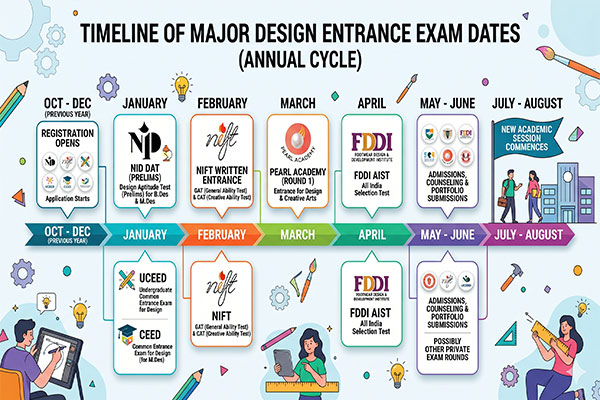
- January to March: Give the exams. Most design entrance exams happen in this window.
- April to June: Results and counselling rounds. Apply to backup private colleges simultaneously.
Frequently Asked Questions
NID DAT can be attempted multiple times (there is no age limit and no restriction on attempts). NIFT allows multiple attempts as well. However, most students try for 1 to 2 years before choosing an alternative path
Yes. Many students crack NID and NIFT with self-study. You need a strong daily drawing practice, a sketchbook, and good design awareness. Coaching helps with structure but is not compulsory.
For most B.Des programs, you need to have passed Class 12. There is generally no minimum age restriction beyond completing the qualifying exam.
Yes. Several good private design colleges admit students based on their Class 12 marks, portfolio, and a basic aptitude test. These colleges often provide very good education and placement outcomes.
Both are highly competitive, but they test different things. NID is more conceptual and requires stronger drawing and design thinking skills. NIFT has a written component (GAT) that tests English and quantitative ability in addition to creativity. Many students who struggle with written tests find NID a better fit, and vice versa.
There are excellent B.Des programs at private design universities that match the quality of IIT design programs in terms of curriculum, faculty, and placement. Do not limit yourself to the IIT brand alone. The design industry values your portfolio and skills more than your college name.