



NIFT vs Private Design Colleges: Which Is Better for You?
Every year, lakhs of students dream of getting into a top design college. For most, the first name that comes to mind is NIFT. It is the most well-known design institute in India and has a very strong reputation.
But here is a fact that many students do not know. There are many excellent private design colleges in India that offer world-class education, great placements, and a learning experience that is sometimes better suited to students with specific needs or goals.
This guide will help you understand the real difference between NIFT and private design colleges so you can make the best choice for your career.
Note: We will not name any specific colleges here. This is about helping you understand what to look for, not just where to go.
What Is NIFT?
NIFT stands for National Institute of Fashion Technology. It is a government-funded design institute with campuses across India. NIFT is primarily known for fashion design, though it also offers courses in fashion technology, fashion management, accessory design, and textile design.
NIFT has strong alumni networks, good industry connections, and a competitive admission process based on a national entrance exam.
What Do Private Design Colleges Offer?
Private design colleges are run by private universities, trusts, or educational groups. They offer a wider range of design specialisations, from UI/UX design and product design to interior design and communication design.
Many private colleges offer innovative, industry-aligned curricula that are updated regularly. They often have more flexibility to partner with companies, bring in guest faculty, and run workshops.
The Key Differences: A Detailed Comparison
| Factor | Government Institutes (like NIFT) | Private Design Colleges |
| Admission Process | National entrance exam, highly competitive | Own entrance test or merit-based, more accessible |
| Specialisations Available | Mainly fashion-focused specialisations | Wide range: UI/UX, product, interior, fashion, communication |
| Fees | Government-subsidised, generally lower | Market-priced, varies by college and program |
| Faculty | Experienced permanent faculty | Mix of academics and working professionals |
| Industry Exposure | Strong alumni network, good for fashion industry | Depends on college; many have strong tech and design industry links |
| Campus Flexibility | Fixed curriculum, harder to change | Often more flexible, project-based learning |
| Student-Teacher Ratio | Can be high in popular batches | Smaller batches at better colleges means more attention |
| International Exposure | Some exchange programs | Often more international collaborations and workshops |
| Placement | Very strong for fashion industry | Strong for tech, interior, product design sectors |
| Research Culture | Strong design research culture | Growing research culture at better private colleges |
The Entrance Exam Factor
One of the biggest differences between NIFT and many private colleges is the admission process.
NIFT Admission
Getting into NIFT requires passing the NIFT Entrance Exam, one of the toughest design entrance exams in India. It tests your creative ability, general English, quantitative ability, and design aptitude. The seats are limited and competition is intense.
Private College Admission
Many good private design colleges have their own admission process. Some have an aptitude test and portfolio review. Some accept students based on their Class 12 marks plus a design aptitude test. Some accept students without any separate entrance exam.
This does not mean the college is inferior. It means more students have a chance to get quality design education, especially those who are talented but not great at written entrance exams.
TIP: If you are a hands-on creative person who expresses better through drawings and projects than written exams, a private college with a portfolio-based admission might give you a fairer chance to show your real talent.
Specialisation: Fashion vs Everything Else
This is the single most important factor for most students.
If you want to become a fashion designer, NIFT is an excellent choice. Its entire system, faculty, industry connections, and alumni network, is built around fashion.
But if you want to become a UI/UX designer, a product designer, an interior designer, or a communication designer, NIFT is not the right fit. For these fields, you need a design college that specialises in those areas.
Simple Rule: NIFT for fashion. Look at strong private colleges for all other design specialisations.
What to Look for in a Private Design College
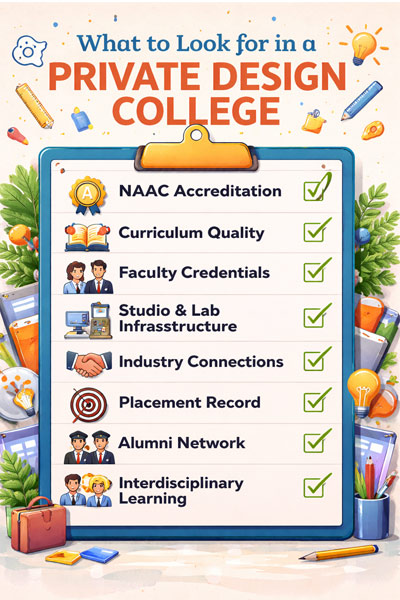
Not all private design colleges are equal. Here is exactly what to check before you take admission in any private design college.
- NAAC Accreditation: Is the college or university accredited by NAAC? A B++ or A grade means the institution meets quality standards.
- Curriculum Quality: Is the curriculum updated regularly? Does it match what the industry actually needs? Ask if they revise it every year.
- Faculty Credentials: Who are the teachers? Do they have real industry experience or only academic experience? The best programs have both.
- Studio and Lab Infrastructure: Design is a hands-on subject. Does the college have proper studios, material labs, computer labs, and workshop spaces?
- Industry Connections: Does the college bring in guest faculty from real companies? Do they run industry-sponsored projects?
- Placement Record: Where have recent graduates been placed? Which companies came to campus? Ask to see actual placement data, not just numbers on a brochure.
- Alumni Network: Can you connect with alumni to ask about their experience? Alumni who are doing well in their careers is a very good sign.
- Interdisciplinary Learning: Design today is multi-disciplinary. Does the program allow you to explore across different design fields, especially in the foundation year?
What About Placements?
Placement records tell you a lot about a college. But look beyond the numbers. Ask these questions.
- What types of companies recruit from this college? Are they design studios, tech companies, fashion houses, or advertising agencies?
- What roles do graduates get? Are they junior designers or does the college produce design leads?
- What is the average and highest salary package offered?
- How many students out of the total batch get placed through campus?
- Do alumni start their own studios or businesses? This shows the entrepreneurship culture.
The Hands-On Learning Difference
One thing that separates the best private design colleges from average ones is the emphasis on hands-on learning. Design is not a subject you can learn from textbooks alone.
The best design programs give students access to material labs, fabrication workshops, digital printing facilities, photography studios, and more. Students work on real briefs from real companies. They go on field trips and residencies. They participate in national and international design competitions.
When you visit a college, look at the studios and workshops. Are they full of work, materials, and evidence of students making things? That is a great sign. Empty studios mean theory-heavy teaching.
The Cultural and Geographic Factor
Where you study design matters more than many students realise. Cities like Ahmedabad, Mumbai, Delhi, and Bangalore have rich design scenes with studios, galleries, fairs, and design events happening throughout the year.
Ahmedabad in particular is one of India’s most design-conscious cities. It is home to India’s first UNESCO World Heritage City, has a long tradition of textile and craft, and has produced some of India’s most influential designers. Studying design in such a city gives you access to a living design laboratory outside your classroom.
Frequently Asked Questions
Not necessarily. NIFT is the best option for fashion design specifically. For other design specialisations like UI/UX, product design, interior design, and communication design, several strong private colleges offer education that is equal to or better than what NIFT offers in those areas.
Many talented students do not clear highly competitive government exams but still go on to have brilliant design careers. A strong private design college with good faculty, infrastructure, and placement record can give you an equally good career launch.
Yes. B.Des degrees from accredited private universities are recognised by UGC (University Grants Commission) and are accepted by employers across India and globally. Always check that the university offering the degree is UGC-recognised.
In most cases, no. Credits from one institution are not easily transferred to another. Choose carefully before enrolling.
Both matter, but your skills matter more in the long run. A great designer from a lesser-known college will eventually outperform a mediocre designer from a famous college. The first job might be harder to get, but skills always win in the end. That said, a good college helps you build skills faster and opens more doors early in your career.
NIFT does not offer specialisations in UI/UX design, product/industrial design, interior design, or general communication design. If any of these is your chosen field, you will need to look at design colleges that offer these programs.