


Choosing an Ahmedabad Design College
You have decided you want to study design. You want to study in Ahmedabad. Now comes the hard part: choosing the right college.
There are several design colleges in Ahmedabad. Some are excellent. Some are average. Some look impressive on a brochure but do not deliver quality education. How do you tell the difference?
This guide gives you a clear, practical checklist for evaluating any design college in Ahmedabad. We will not name specific colleges or compare fees here. Instead, we will teach you exactly what questions to ask and what to look for so you can make your own smart decision.
Why Ahmedabad for Design?
Before we talk about how to choose a college, let us talk about why Ahmedabad is a great city to study design.
- Ahmedabad is India’s first UNESCO World Heritage City. Walking through the old city is like walking through a living design museum.
- The city has a rich tradition of textiles, crafts, architecture, and visual arts going back centuries.
- Ahmedabad is home to some of India’s leading design institutions and has produced many of India’s most respected designers.
- The city has a strong entrepreneurial spirit. Many design studios, startups, and creative businesses operate here.
- The cost of living is reasonable compared to Mumbai or Delhi, making it more accessible for students from different backgrounds.
The 10-Point Checklist for Evaluating a Design College
This is the most important question. Make sure the college offering you admission is a UGC-recognised university or affiliated to one. A B.Des degree from a non-recognised institution is not valid for further education or professional use.
Also check if the university is NAAC accredited. A NAAC grade of B++ or A is a sign of quality education standards.
Does the college offer the specific design discipline you are interested in? Not all colleges offer all specialisations. Make sure your chosen field, whether it is UI/UX, fashion, product, interior, or communication design, is taught properly, not just mentioned as an afterthought.
The quality of faculty is the most important factor in the quality of your education. Look for:
- Faculty who have real industry experience, not just academic qualifications
- Faculty who are active in their design fields, doing actual design work alongside teaching
- A good balance between permanent faculty and visiting industry professionals
- Faculty-student ratio that allows personal attention
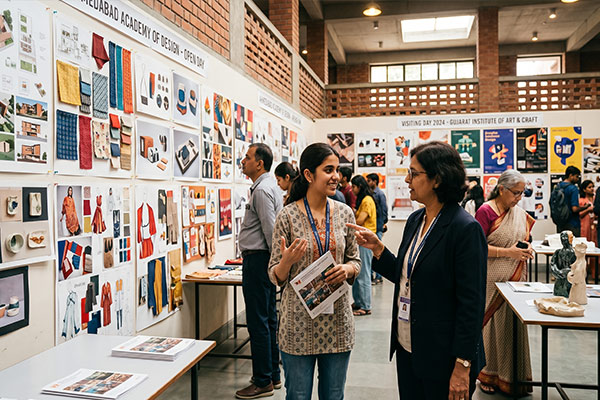
Design education is hands-on. Visit the campus. Look at the studios, workshops, and labs. Ask yourself:
- Are the studios full of student work and creative energy?
- Is there a materials lab where students can work with physical materials?
- Is there a well-equipped computer lab with industry-standard software?
- Is there a fabrication workshop or maker space?
- Is there a library with good design books, journals, and archives?
Visit Rule: If the studios are empty and the walls are bare, walk away. Great design schools are messy, busy, creative places.
Ask to see the actual curriculum. Is it updated regularly? Does it include both traditional design skills and modern digital tools? Does it include research methodology? Does it connect to Indian design heritage? Does it have industry-integrated projects?
A curriculum that was last updated 10 years ago is a red flag. Design, especially digital design, changes very fast.
Placement data is important, but look beyond the numbers. Ask:
- What percentage of graduating students are placed through campus placements?
- Which companies recruit from this college?
- What roles do graduates typically start in?
- What is the average salary package for recent graduates?
- Do graduates also start their own studios or businesses?
- Can you speak to recent alumni about their experience?
Good design education does not happen only inside the classroom. Ask about:
- Are there live projects from real industry clients?
- Do working designers visit as guest faculty regularly?
- Are there workshops by industry professionals throughout the year?
- Does the college have any partnerships or MOUs with design companies?
- Are there opportunities for students to exhibit their work publicly?
Design students learn a lot from each other and from activities outside class. Ask about:
- Are there design clubs, student associations, or creative societies?
- Does the college participate in national design competitions like NID’s competitions or D-show events?
- Are there cultural and design events hosted on campus?
- Is there a culture of student-initiated projects and entrepreneurship?
Where the college is located within Ahmedabad also matters. A campus near the city centre has easier access to museums, design studios, markets, and industry offices. A campus far from the city makes it harder to attend events, exhibitions, and networking opportunities.
For design students especially, the ability to step out and observe the real world is important. Ask how often field trips and city-based activities are organised.
The best source of information about any college is its current students. When you visit, talk to students informally. Ask them honestly:
- Are you happy with the quality of teaching?
- Do you feel you are learning the right things for the industry?
- What would you change about this college if you could?
- Do you feel supported by the faculty?
- What is the college’s best quality and biggest weakness?
Red Flags to Watch Out For
Here are signs that a design college may not be right for you.
| Red Flag | What It Signals |
| No campus visit allowed before admission | The college may have poor facilities they do not want you to see |
| No placement data available | Poor placement record or no systematic support for job hunting |
| Curriculum not updated in many years | Old and irrelevant education that does not match industry needs |
| No information about faculty qualifications | Faculty may lack real experience or credentials |
| Very few guest lectures or industry events | Little connection to the real design world |
| Students seem unhappy or disengaged when you visit | Culture and environment may not support learning |
| Degree not UGC-recognised or university not NAAC accredited | Your degree may not be valid for jobs or further study |
Questions to Ask During the Admissions Process
- Can I see the full 4-year curriculum for my chosen specialisation?
- Who are the faculty members for my specialisation? Can I speak with them?
- What is your placement record for the last 3 graduating batches?
- Which companies recruited from your campus last year?
- Do you have active industry partnerships or MoUs with design companies?
- How many students are in each batch? What is the faculty-to-student ratio?
- What software and tools will I have access to in your computer labs?
- What makes your design program different from other design colleges in Ahmedabad?
- Are there scholarships available and what is the process to apply?
- Can I speak with students or alumni from the program I am applying to?
TIP: Take notes during your college visit. Compare your notes after visiting multiple colleges. The one that excites you the most and gives the clearest, most confident answers to your questions is usually the right choice.
Frequently Asked Questions
Ahmedabad has several design colleges and universities offering design programs. They range from government institutions to private universities. The best way to evaluate them is using the 10-point checklist in this article.
Yes. Ahmedabad’s old city area (Walled City) is a UNESCO World Heritage Site and a constant source of design inspiration. Colleges that organise regular visits to markets, craft traditions, and architecture in and around the city provide richer education experiences.
Request a virtual campus tour. Ask for student contact details so you can speak to current students online. Look for genuine student reviews on Google, YouTube, and social media. Do not take admission without doing this research.
It is more important to go where your specific interest is strong. A college that is generally well-known but mediocre in your specific specialisation is less valuable than a college with exceptional faculty and industry connections in your area of interest.
Rankings can give a rough idea but should not be the only deciding factor. Rankings are often based on general university metrics, not specifically on design education quality. The factors in the checklist in this article are more reliable indicators of quality for your design education specifically.