

Why Design Students Love Ahmedabad
When students and parents think about the best cities to study design in India, they usually mention Mumbai, Delhi, or Bangalore. These are all great cities for design careers. But there is one city that often gets overlooked, and it may actually be the most powerful city of all for a design student.
That city is Ahmedabad.
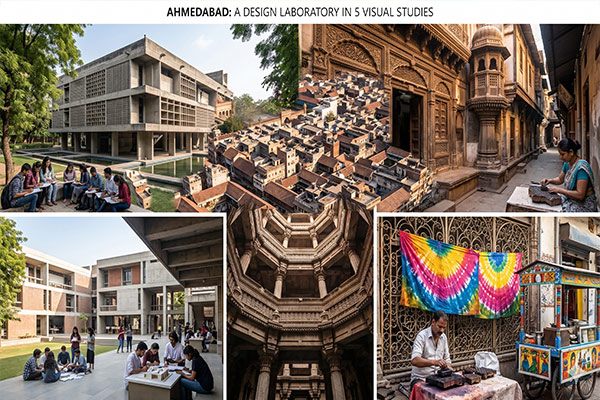
Ahmedabad is not just a good city for design. It is a living design school. Walk through its streets and you are surrounded by centuries of design thinking. Study here and you learn from both ancient masters and modern innovators at the same time.
Let us explain exactly why Ahmedabad is such a special place to study design.
India’s First UNESCO World Heritage City
In 2017, Ahmedabad became India’s first UNESCO World Heritage City. This recognition was given for the city’s extraordinary collection of historic architecture, its unique pol house system, and its long history of cultural and artistic achievement.
The Walled City of Ahmedabad is a masterclass in urban design. The pol system, a network of interconnected residential clusters with their own water supplies, temples, and shared spaces, is one of the most intelligent community design solutions in the world. For a design student, walking through these pols is a lesson in space, community, sustainability, and cultural identity.
A City Built by Craftspeople
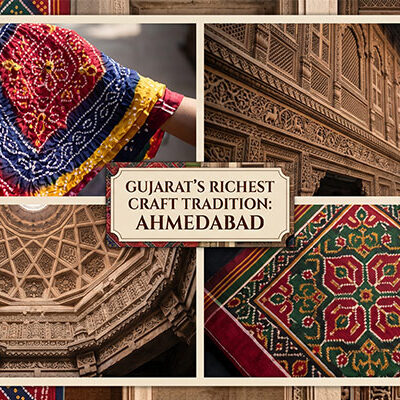
Gujarat has one of the richest craft traditions in all of India. And Ahmedabad is its creative heart.
Textiles and Weaving
Ahmedabad has been a centre of textile production for over 600 years. The city’s cotton mills were legendary. Today, artisans in and around Ahmedabad produce some of India’s most celebrated hand-block prints, weaves, and embroideries.
- Bandhani (tie-dye) is one of the oldest textile arts of Gujarat
- Patola silk weaving from nearby Patan is recognised globally for its extraordinary precision
- Block printing traditions from Pethapur and Bagru connect Ahmedabad to India’s design heritage
- Ahir and Rabari embroideries show intricate visual languages developed over generations
Architecture and Craft
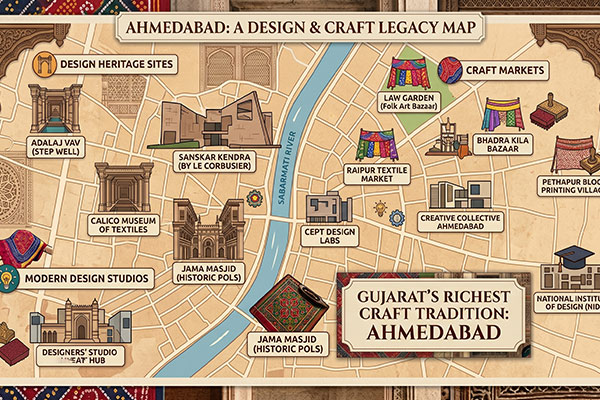
Ahmedabad’s architecture tells stories in wood, stone, and brick. The intricate carved wooden facades of pol houses are a lesson in scale, pattern, and ornament. The step wells (vavs) of Gujarat, like the stunning Adalaj Vav near Ahmedabad, show a design philosophy that combines function, beauty, and spirituality in ways that still inspire designers today.
For a design student, these are not just tourist attractions. They are primary sources of design knowledge.
Design Insight: The best design programs teach students to learn from the design intelligence embedded in their own culture, not just from Western design textbooks.
The Decolonising Design Movement and Why Ahmedabad Matters
There is a growing movement in the global design world called decolonising design. It challenges the idea that all good design comes from the West. It argues that design traditions from India, Africa, and Asia have been overlooked for too long and have enormous things to teach the modern world.
Ahmedabad is at the centre of this movement in India. Designers here have long argued that Indian design traditions, from Vastu Shastra to traditional textile patterns to classical architecture, contain deep design intelligence that is relevant to modern problems.
Students who study design in Ahmedabad naturally absorb this perspective. They develop a design voice that is both globally informed and locally rooted. This is a powerful competitive advantage in today’s world, where global brands are increasingly interested in authentic, culturally-grounded design.
A Thriving Modern Design Ecosystem
Ahmedabad is not just a city of the past. It is a modern, thriving design city.
Growing Startup and Business Scene
Ahmedabad is one of India’s most business-active cities. The Gujarat International Finance Tec-City (GIFT City), the expanding startup ecosystem, and the city’s strong MSME sector create thousands of design opportunities for students and young designers.
Every new brand, every digital product, every retail space being built in Ahmedabad and Gujarat needs designers. Students who study here build connections in this ecosystem from day one.
International Connectivity
Ahmedabad is one of the most internationally connected cities in India. The Gujarati diaspora spans the UK, the USA, East Africa, and Southeast Asia. This global connection means Ahmedabad-based designers often have access to international projects, international perspectives, and international career opportunities.
Design Events and Festivals
Ahmedabad hosts several important design-related events through the year. From Uttarayan (the Kite Festival) which is a masterclass in colour, movement, and joy, to craft bazaars where artisans from across India gather, to architecture walks and heritage tours, design students in Ahmedabad are surrounded by inspiration 365 days a year.
The Interdisciplinary Design Advantage
Modern design problems are complex. They require knowledge from many fields: technology, sociology, history, psychology, business, and art. Ahmedabad is a city that naturally offers all of these.
A design student in Ahmedabad can:
- Study traditional craft techniques from masters still practising ancient methods
- Observe how modern architecture grapples with climate, community, and culture
- Work with local businesses on real branding and product design challenges
- Draw on a visual vocabulary developed over centuries in the city around them
- Engage with a diverse, multi-cultural community that reflects the full range of India’s society
Lower Cost of Living Without Compromising Quality
Compared to Mumbai, Delhi, or Bangalore, Ahmedabad offers a significantly lower cost of living. Food, housing, and transport are more affordable. This means students can focus more on their education and creative work, and less on financial stress.
At the same time, quality of life in Ahmedabad is high. The city has excellent food, good connectivity, safe neighbourhoods, and a strong community culture. It is a city that is easy to live in.
Ahmedabad Designers Who Have Changed India
Ahmedabad has produced some of India’s most transformative designers. The legacy of design thinking in this city is long and deep.
From architects who reimagined Indian modernism to textile designers who brought traditional crafts to global runways to product designers who found solutions for rural India in its own craft traditions, Ahmedabad designers have consistently shown the world what happens when design is rooted in cultural knowledge and human understanding.
As a design student in Ahmedabad, you are part of this lineage. You have access to this history, this wisdom, and this inspiration every single day.
What Studying Design in Ahmedabad Does for You
| Benefit | What It Means for You as a Designer |
| Access to living craft traditions | You learn from masters, not just textbooks. Your work has depth and authenticity. |
| Heritage architecture all around | Your sense of space, proportion, and ornament develops naturally. |
| Strong business culture | Real clients, real briefs, real problems to solve while still studying. |
| Decolonised design perspective | You develop a unique design voice that is globally competitive and culturally grounded. |
| International connectivity | Exposure to global perspectives through the city’s diaspora connections. |
| Affordable cost of living | You can focus on your education without financial stress. |
| Design-conscious community | You live among people who appreciate, critique, and celebrate good design. |
Frequently Asked Questions
Yes. Ahmedabad has a growing number of design studios, advertising agencies, branding firms, architecture offices, fashion labels, and technology companies. The city’s strong business environment also means many new brands and startups are always looking for designers.
Gujarati and Hindi are widely spoken in Ahmedabad, but English is commonly used in design studios, tech companies, and academic settings. Non-Gujarati students generally adapt very quickly. Many design schools in Ahmedabad have students from all over India, creating a diverse and welcoming environment.
Decolonising design is the movement to recognise and value design knowledge from non-Western cultures. For an Indian design student, it means learning to draw on India’s own rich design heritage and not just copying Western design trends. This makes Indian designers more original, more culturally relevant, and more interesting to global clients looking for authentic perspectives.
Ahmedabad has active craft hubs, artisan markets, and NGOs that work with traditional craft communities. Good design schools organise regular field trips and residencies to craft villages. Students can also independently visit markets like Law Garden Night Market, Manek Chowk, and the weavers of Patan on their own time.
Ahmedabad consistently ranks among the safer large cities in India. It has good infrastructure, a culture of hospitality, and strong student communities from across India. Students from all over the country study and live comfortably in Ahmedabad.
Mumbai and Delhi are excellent design cities, but they are expensive, crowded, and fast-paced. Ahmedabad gives you access to equally strong design education and industry connections, but with a better quality of life, lower costs, and the unique advantage of being embedded in one of India’s richest design heritage environments. For a design student who wants depth and not just trend exposure, Ahmedabad offers something Mumbai and Delhi cannot.